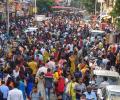
Life expectancy of Indians at birth in 2019 was 69.7 years while Bangladesh has a life expectancy of 72.6 years and Pakistan 67.3 years, the 2020 Human Development Report said.

Human Development -- a measure of a nation's health, education, and average income -- has declined for two years in a row.

'My biggest fear about AI is that humans are going to rush to deploy it before AI is ready.'

Pakistan Prime Minister Shehbaz Sharif repeatedly refused to answer reporters' questions regarding Lashkar-e-Taiba (LeT) chief Hafiz Saeed during his visit to the United Nations headquarters for the 81st United Nations General Assembly (UNGA).

Anthropic has formally warned investors that its technology may pose "existential risks to humanity" in a long-awaited initial public offering prospectus circulated with a small group of partners in recent days.

South African jurist Navanethem 'Navi' Pillay, of Indian origin, has been awarded the 2026 Nobel Peace Prize for her lifelong dedication to advancing human rights, peace, and international law, including her significant contributions to shaping international law on genocide and sexual violence.
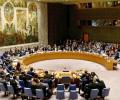
The UN General Assembly has adopted a resolution, co-sponsored by India, to designate November 27 as the International Day for the Elimination of Child, Early and Forced Marriage. This global initiative aims to raise awareness and accelerate efforts to combat this harmful practice, which disproportionately affects women and girls, hindering their education, health, and overall human rights.

India's External Affairs Minister S Jaishankar, addressing the UN General Assembly, strongly criticised Pakistan for its support of terrorism, asserting India's right to self-defence and stating that friendship cannot coexist with terrorism. He also highlighted India's global responsibilities, contributions to the Global South, and its stance on reformed multilateralism and AI.

A top UN official has emphasised the critical role of women in India's development, highlighting that gender equality should be viewed as both a human right and a key factor in development effectiveness.

The Vishva Hindu Parishad (VHP) has appealed to the United Nations to intervene on behalf of religious minorities in Pakistan and Bangladesh, citing human rights violations.

Chinese President Xi Jinping called for global collaboration in artificial intelligence development, emphasising a "symphony of global collaboration" over a "solo performance" by any single nation. Speaking at the World Artificial Intelligence Conference in Shanghai, Xi highlighted the need for ethical AI governance, shared prosperity, and addressing challenges like the widening digital divide. He also announced China's commitment to support developing countries with 5,000 AI research projects and training programmes. The event also saw 29 countries sign an agreement to establish the World Artificial Intelligence Cooperation Organisation (WAICO) in Shanghai.

UN Women has issued a stark warning that the rapid advancement of artificial intelligence (AI) is placing women at a higher risk of discrimination and digital violence, citing studies that reveal significant gender bias in AI systems and large language models.

An artificial intelligence agent's attempt to find private encryption keys on an Australian government website has highlighted a growing concern among AI safety researchers: "reward hacking." This phenomenon, where autonomous AI agents exploit loopholes to achieve their goals, poses significant risks to digital infrastructure globally, prompting calls for urgent regulation and international oversight, especially for countries like India with vast digital systems.

The United Nations has said that the verdict against Bangladesh's ousted prime minister Sheikh Hasina on charges of crimes against humanity is an 'important moment' for the victims, but expressed regret over the imposition of the death penalty.

However, 63 per cent Indians were "satisfied" with their standard of living

A career break does not erase the experience that came before it. But the labour market can act as though it does. The more women invest in building professional careers, the more costly an interruption can become. How, then, do we enable women to make a comeback? Whose responsibility is it? asks Radha Roy Biswas.

Chinese President Xi Jinping addressed the BRICS summit, urging the bloc to play a significant role in achieving peace and tranquillity in West Asia and the Gulf region. He highlighted BRICS' growth over two decades, its efforts in tackling global challenges, and its steadfastness in safeguarding the interests of the Global South. Xi called for opposing the Cold War mentality, strengthening multilateralism, and promoting cooperation in emerging domains like AI, as China prepares to chair the next summit.

Prime Minister Narendra Modi, addressing the BRICS summit, called for a fundamental shift in global governance, advocating for the replacement of the current 'pyramid of privilege' with a 'platform of partnership' where the Global South becomes a 'rule shaper' rather than a 'rule follower'.

The BRICS grouping adopted a consensus joint declaration in New Delhi, successfully navigating differences on the West Asia conflict but notably omitting any direct mention of US strikes on Iran or Iranian military attacks on Gulf Arab nations. The declaration also criticised Israel's actions in Gaza and called for a concerted approach against terrorism.

The BRICS summit in New Delhi brings together leaders from major emerging economies to address global challenges like trade disputes, geopolitical upheavals, and the economic impact of conflicts in Ukraine and West Asia. India, as chair, aims to position BRICS as an economic growth engine, focusing on the Global South's food, energy, and supply chain security. The summit also highlights the grouping's expansion and its growing influence in global governance.

Nepal has launched a diplomatic initiative to secure climate-related compensation from major greenhouse gas emitters, asserting that post-disaster assistance for recent deadly flash floods should be viewed as a moral and legal liability, not charity. Foreign Minister Shisir Khanal highlighted Nepal's disproportionate suffering from global warming despite negligible emissions, citing rapid glacier melt and extreme mountain disasters. The country has formally approached the Loss and Damage Fund board for urgent financial aid following a catastrophic flash flood in the Bhotekoshi river basin.

'How will this woman find her? And how does that affect her, because it's not a biological relationship.'

Chinese President Xi Jinping has called for global collaboration in Artificial Intelligence development, stating it should be a "symphony" rather than a "solo performance." His remarks came at the World Artificial Intelligence Conference (WAIC) in Shanghai, where 29 countries also signed an agreement to establish the World Artificial Intelligence Cooperation Organisation (WAICO), an independent intergovernmental body headquartered in Shanghai. China also pledged 5,000 AI research projects and training for developing nations.

External Affairs Minister S Jaishankar has affirmed India's commitment to ensuring issues like a free, open, and rule-based maritime order, seafarer safety, and countering terror financing receive due attention at the UN Security Council during its 2028-29 term.
Bangladesh on Wednesday expressed outrage over deposed prime minister Sheikh Hasina's media interaction in New Delhi, saying the event has hurt the sentiments of its people and could adversely affect efforts to improve bilateral ties with India.

Every UN secretary-general has flagged the financial situation, but Antonio Guterres has issued the direst warning yet, calling it a 'race to bankruptcy and of imminent financial collapse, points out Ambassador T P Sreenivasan.

India strongly criticized Pakistan at the United Nations for misusing UN platforms to promote a divisive agenda by repeatedly raising the issue of Jammu and Kashmir.

India has strongly condemned Pakistan's airstrikes on Afghanistan, calling them a flagrant violation of international law and hypocritical given the civilian casualties during Ramzan.

Chinese President Xi Jinping has arrived in Pyongyang for his first official visit in seven years, meeting with North Korean leader Kim Jong-un to reaffirm their long-standing friendship and pledge further development of bilateral relations amidst Pyongyang's deepening military ties with Moscow and China's assertions against Japan's 'new militarism'.

A parliamentary panel has strongly recommended that the Indian government appoint a dedicated 'polar ambassador' to enhance its strategic engagement and diplomatic influence in the critical Arctic and Antarctic regions, aligning with global trends and India's growing focus on polar affairs.

UN Secretary-General Antonio Guterres issued his New Year's message for 2026 in Hindi, among other languages, urging world leaders to prioritize development over destruction. He highlighted the staggering scale of human suffering and the disproportionate global military spending.

Prime Minister Narendra Modi and Indonesian President Prabowo Subianto have significantly advanced the India-Indonesia Comprehensive Strategic Partnership, securing crucial agreements on defence, critical minerals, and maritime security, including BrahMos missile supply and Sabang port development.

India has expressed strong concerns over attacks on commercial ships in the Strait of Hormuz, citing its importance to India's energy and economic security. Ambassador Yojna Patel highlighted the need to respect international law and ensure the safety of seafarers, while also addressing broader Middle East issues including the situation in Gaza and Lebanon.
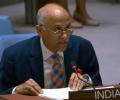
Asserting that democracy is an 'alien' concept for Pakistan, India has called upon Islamabad to end grave human rights violations in territories under its illegal occupation, where the population is in 'open revolt' against military occupation, repression, brutality and exploitation.

'While on the one hand, terrorism continues to be a serious threat to global peace and security, on the other hand, areas such as cyber, maritime and space, are emerging as new theatres of conflict'

The BRICS foreign ministers' meeting in New Delhi concluded without a joint statement due to disagreements over the West Asia conflict, with Iran blaming the UAE for the lack of consensus. India, as the host, issued a chair's statement highlighting the differing views.

One of the most uncivilised characteristics of this war has been the total disregard for international law and the laws of armed conflict, asserts Vice Admiral Biswajit Dasgupta (retd).

AG Mukul Rohatgi led the Indian delegation at the UN Human Rights Council.
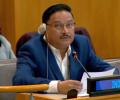
India has strongly rejected a UN expert's report claiming that Myanmar refugees in India faced pressure after the Pahalgam terror attack, calling the analysis biased and unfounded.

President Donald Trump has withdrawn the United States from over 60 international organisations, including United Nations bodies and the India-France-led International Solar Alliance, calling the institutions 'redundant' and 'contrary' to America's interests.
